
Mastering Carbon Credit Monetization is no longer an alternative revenue concept; it is a foundational financial strategy for global agroforestry projects and institutional land developers in 2026. As corporate commitments to net-zero emissions face intense regulatory scrutiny, the global demand for high-quality, nature-based carbon removals has skyrocketed. Institutional buyers—ranging from multinational tech conglomerates to sovereign wealth funds—are aggressively hunting for premium carbon assets to offset their Scope 3 emissions.
Related Insights


However, these buyers have zero tolerance for unverified assets. The historical era of generating cheap, opaque carbon credits has been completely dismantled by stringent regulatory frameworks. Today, navigating the complex process of Carbon Credit Monetization requires developers to bridge the physical reality of rural agriculture with the rigorous compliance mechanisms of international carbon markets. Projects that successfully achieve this alignment transform rural land from a low-margin commodity producer into a high-yield, institutional-grade ecological asset.
For project developers and capital allocators, agroforestry represents the gold standard of nature-based solutions. By integrating trees into agricultural landscapes, these projects sequester massive volumes of atmospheric carbon while simultaneously restoring soil health and providing socio-economic resilience to rural communities. However, transforming these biological processes into tradable financial instruments is a highly technical endeavor.
This operational guide breaks down the strategic step-by-step process of how rural agroforestry initiatives can verify, issue, and execute Carbon Credit Monetization strategies to attract premium institutional buyers in the modern carbon economy.
1. Establishing the Baseline Methodology and Additionality
The foundational step in Carbon Credit Monetization is establishing a scientifically defensible “baseline methodology.” A baseline represents the hypothetical scenario of what would have happened to the land’s carbon stocks if the agroforestry project had never been implemented. If the land would have naturally regenerated into a forest anyway, the project generates no tradable value. Therefore, developers must conduct rigorous geospatial and historical analyses to prove that the land was degraded and would remain so without the intervention of institutional capital.
Related Insights


Equally critical is the concept of “Additionality.” To qualify for international carbon markets, a project developer must definitively prove that the carbon sequestration is entirely dependent on the carbon finance itself. If the agroforestry project is already highly profitable through timber or fruit sales alone, auditors will reject the carbon credits, arguing that the trees would have been planted regardless.
Navigating this financial additionality test requires sophisticated economic modeling, ensuring that the project’s internal rate of return (IRR) explicitly relies on future carbon revenues. This rigorous front-end validation protects the project from the structural vulnerabilities detailed in our previous analysis of carbon compliance and land tenure risks.
2. Selecting the Right Standard: VCS vs. Gold Standard
Choosing the correct international certification standard is vital for maximizing Carbon Credit Monetization revenue. Institutional buyers do not purchase generic credits; they purchase credits backed by globally recognized registries. The two dominant frameworks in the nature-based sector are the Verified Carbon Standard (VCS) managed by Verra, and the Gold Standard.
VCS is the largest and most liquid registry globally, offering highly scalable methodologies for Afforestation, Reforestation, and Revegetation (ARR). It is typically favored for massive, landscape-scale projects where sheer volume is the primary financial driver. Conversely, the Gold Standard mandates rigorous, verifiable contributions to the UN Sustainable Development Goals (SDGs), demanding strict proof of local socio-economic co-benefits alongside carbon sequestration. While Gold Standard certification involves a more exhaustive and expensive auditing process, the resulting credits frequently command a significant price premium in the market. Buyers are willing to pay up to 30% more for credits that objectively prove they are elevating rural livelihoods, aligning perfectly with strategies focused on integrating ESG metrics into institutional capital allocation.

3. The PDD and Third-Party Validation Process
Once the methodology is selected, the developer must draft the Project Design Document (PDD). This comprehensive dossier outlines every technical parameter of the project, including carbon accounting formulas, leakage deductions (ensuring that preventing deforestation in one area doesn’t simply shift it to another), and community engagement protocols. Completing the PDD is a critical milestone in Carbon Credit Monetization, marking the transition from project conception to regulatory scrutiny.
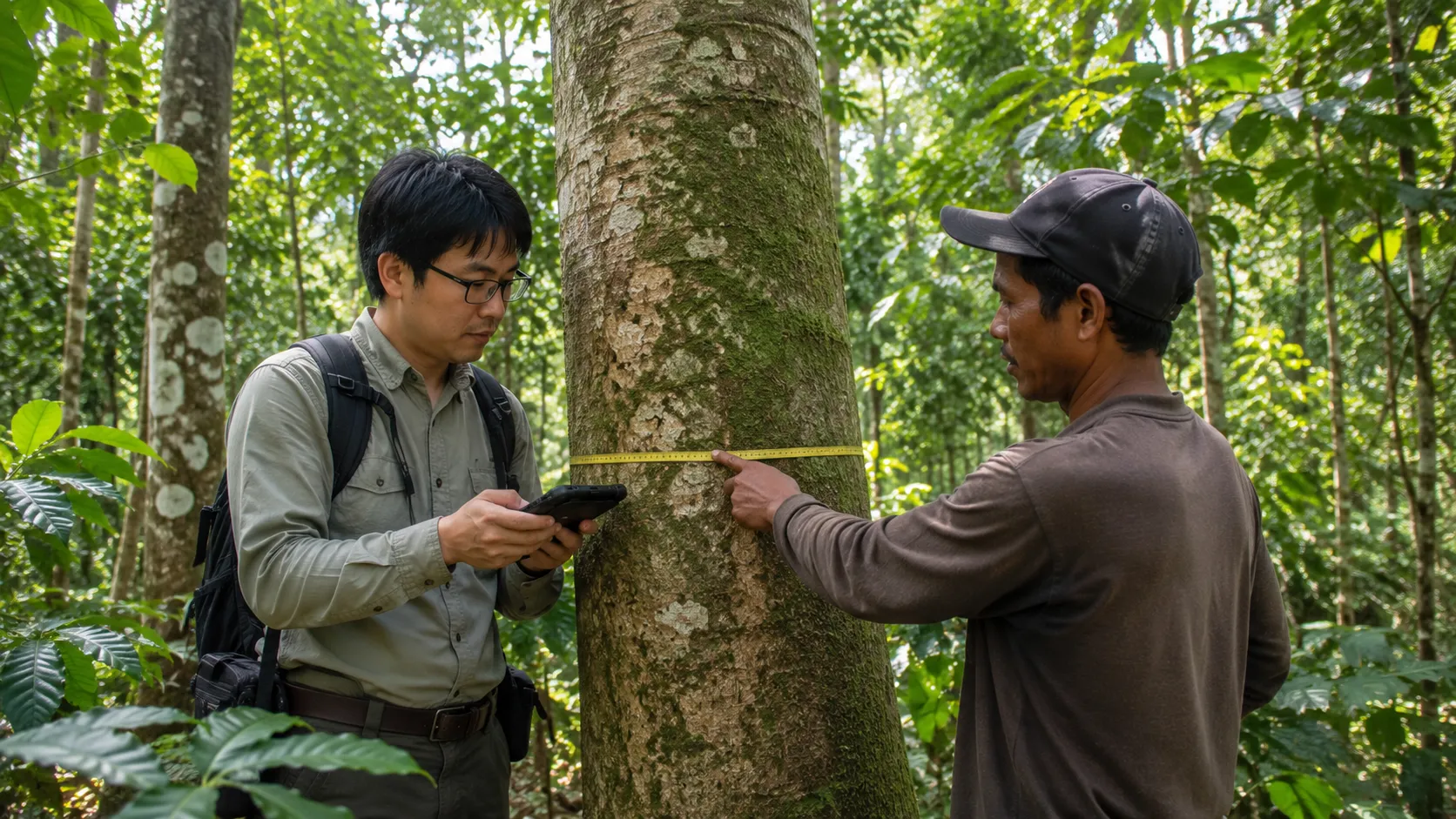
The PDD is subsequently subjected to a grueling audit by an independent Validation and Verification Body (VVB). These authorized third-party firms deploy environmental scientists and financial auditors to the field to cross-reference the document’s claims against the physical reality of the plantation. The VVB process is inherently adversarial; auditors are incentivized to find flaws in the developer’s carbon math. Consequently, utilizing automated measurement tools—such as LiDAR drones and continuous soil sensors—dramatically accelerates this phase, replacing arguable human estimations with immutable digital facts.
4. Verification and Credit Issuance
Validation merely approves the project’s design; actual credit issuance requires ongoing verification. The physical reality of Carbon Credit Monetization dictates that credits are issued ex-post—meaning they are only generated after the carbon has been verifiably drawn out of the atmosphere. In agroforestry, this typically occurs in five-year verification cycles.
During a verification event, the VVB returns to the site to measure the actual growth of the biomass against the projections outlined in the PDD. If an unexpected drought reduced tree growth by 15%, the issuance of Verified Carbon Units (VCUs) will be proportionally reduced. To hedge against this inherent biological volatility, developers must maintain a “buffer pool”, holding back a mandatory percentage of credits in an un-tradable reserve. This mechanism ensures that if a localized wildfire destroys a portion of the project, the overall integrity of the issued credits remains intact. Managing this buffer effectively is critical for organizations navigating liquidity risks in rural microfinance and agriculture, as it directly impacts expected cash flows.
5. Structuring Institutional Offtake Agreements
The ultimate goal of Carbon Credit Monetization is not merely holding credits in a registry account, but executing highly profitable sales to institutional buyers. Waiting five years for the first ex-post issuance to generate revenue creates a massive funding gap for the developer, who must pay for land preparation, saplings, and labor upfront.
To solve this, a highly effective Carbon Credit Monetization strategy involves structuring Emission Reduction Purchase Agreements (ERPAs) or forward offtake contracts. In an ERPA, an institutional buyer agrees to purchase a guaranteed volume of future credits at a pre-negotiated floor price, often providing upfront capital to jump-start the project. In exchange for providing this early-stage liquidity, the buyer secures a reliable pipeline of high-quality credits to hedge against future regulatory tightening governed by the UNFCCC. These bilateral agreements transform volatile spot-market carbon pricing into a predictable, bankable revenue stream.
6. A 90-Day Execution Roadmap for Developers
For land developers and rural cooperatives seeking to enter the institutional carbon market, we recommend an accelerated roadmap for Carbon Credit Monetization to establish an immediate competitive advantage:
- Days 1-30 (Feasibility and Geospatial Audit): Engage a specialized carbon consultancy to conduct a pre-feasibility study. Utilize historical satellite data to prove land eligibility, establish the baseline scenario, and conduct a preliminary financial additionality stress test.
- Days 31-60 (Standard Selection & PDD Drafting): Decide between VCS and Gold Standard based on the project’s capacity to prove socio-economic co-benefits. Begin the exhaustive drafting of the Project Design Document, mapping out the precise carbon accounting algorithms.
- Days 61-90 (Offtake Roadshow): Before committing millions to physical planting, utilize the draft PDD to initiate a roadshow for corporate buyers and ESG funds. Secure a binding ERPA with a reputable institution to guarantee a minimum floor price, de-risking the massive upfront capital expenditure.
Conclusion
The institutional pursuit of Carbon Credit Monetization represents a historic convergence of environmental stewardship and high-level corporate finance. Agroforestry projects possess the unique ability to deliver premium, verifiable carbon removals alongside profound socio-economic impacts in emerging rural markets. However, the path from planting a sapling to retiring a verified credit is fraught with complex regulatory, technical, and financial hurdles.
By strictly adhering to international methodologies, leveraging automated verification technology, and securing institutional offtake agreements, developers can effectively bridge the gap between agrarian reality and global compliance markets. Ultimately, mastering Carbon Credit Monetization will separate the next generation of highly capitalized, institutional-grade environmental assets from the obsolete, unverified projects of the past.