

AI-driven credit scoring has emerged as a revolutionary financial technology, dismantling the historical barriers that have kept hundreds of millions of smallholder farmers excluded from the formal banking ecosystem. Across developing economies, small-scale agriculture serves as the primary economic engine, employing massive segments of the rural workforce and sustaining regional food supply chains.
Related Insights


Yet, despite their vital role, these farmers have historically been deemed “unbankable” by traditional commercial banking institutions. Because they operate predominantly within informal cash economies, lack official property deeds to offer as collateral, and possess no formal credit history, they are effectively invisible to traditional risk assessment models. However, the rapid proliferation of smartphones and digital mobile networks throughout rural communities is changing this dynamic. By deploying sophisticated machine learning models to analyze alternative digital footprints, AI-driven credit scoring is transforming thin-file and no-file farmers into highly visible, creditworthy borrowers.
As we navigate through 2026, the global shift toward automated, data-driven financial underwriting has reached a critical tipping point. Financial institutions and agritech platforms are shifting away from rigid, legacy underwriting frameworks that rely on backward-looking financial statements. Instead, modern risk management relies on real-time behavioral analytics and predictive data parsing.
For unbanked smallholders, their smartphone is no longer just a communication tool; it functions as a comprehensive financial passport. By evaluating everyday smartphone interactions, digital wallet velocity, and local agronomic variables, AI-driven credit scoring allows lenders to accurately quantify risk, slash administrative overhead, and distribute essential working capital to rural communities with unprecedented speed and precision.
The Structural Gridlock: Why Traditional Credit Scoring Fails Rural Producers
To understand the profound impact of alternative algorithmic risk assessment, one must first analyze why legacy credit metrics have systematically failed the rural agricultural sector. Traditional commercial banking infrastructure was built to serve urban, salaried populations with highly predictable monthly cash flows and verifiable physical assets. When these legacy underwriting methodologies are applied to remote agrarian contexts, the system breaks down entirely.
Related Insights

- The Core Information Void: Because unbanked farmers have never possessed a standard credit card or a formal bank account, centralized credit bureaus contain zero data on their financial habits, resulting in an immediate automated rejection by legacy banking systems.
- Collateral Mismatch: Traditional loans require formal collateral, such as a legally registered land title. In many rural regions, land is held through complex communal or ancestral arrangements, leaving farmers with no state-sanctioned paperwork to pledge as security.
- Seasonal Income Disruption: Agrarian cash flows are highly volatile and cyclical, featuring large upfront expenditures during planting followed by a single influx of capital months later at harvest. Traditional rigid monthly repayment schedules fail to accommodate this natural agricultural cycle.
This systemic institutional gridlock has historically trapped rural populations in a vicious economic loop. Without access to fair, low-interest working capital, farmers are unable to purchase high-yield certified seeds, modern fertilizers, or automated drip irrigation machinery. This lack of investment keeps their crop yields low and prevents them from generating the surplus income necessary to escape poverty, underscoring the urgent global necessity for advanced AI-driven credit scoring solutions.
Dismantling the Information Void: How AI Maps the Alternative Digital Footprint
The core breakthrough of modern AI-driven credit scoring lies in its unique ability to convert raw, non-traditional digital interactions into a highly predictive, standardized credit metric. Even in deeply isolated rural villages, the adoption of basic smartphone technology has skyrocketed. As farmers use their mobile devices to manage daily life, they generate a rich, continuous stream of data known as an alternative digital footprint. Advanced machine learning algorithms seamlessly harvest and process this telemetry to evaluate a borrower’s financial character and repayment capacity in real time.
Instead of looking for traditional bank statements, the AI analyzes the user’s mobile money wallet velocity. It evaluates how consistently a farmer tops up their airtime, pays local utility bills, or sends peer-to-peer transfers to family members. The algorithm looks closely at behavioral metadata, such as network stability and digital consistency. For instance, a farmer who maintains regular, long-term communication with agricultural input suppliers and consistently pays their mobile data bills demonstrates high behavioral reliability. By analyzing thousands of these discrete, alternative variables simultaneously, the AI can construct a highly accurate risk profile, allowing lenders to extend credit without requiring a single piece of physical paperwork.
The Agronomic Layer: Merging Human Behavior with Earth Observation
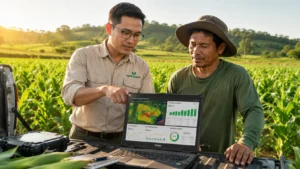
What elevates agricultural AI-driven credit scoring above standard urban fintech lending is the brilliant integration of hyper-local agronomic data. Advanced lending platforms do not analyze smartphone data in isolation; they automatically merge the applicant’s behavioral metrics with real-time earth observation data. When a farmer applies for a digital micro-loan, they drop a digital pin to geolocate the exact boundaries of their agricultural plot through the mobile application.
The machine learning algorithm then cross-references these geographic coordinates with historical and real-time multi-spectral satellite imagery. The AI evaluates critical environmental variables, including the Normalized Difference Vegetation Index (NDVI) to track historical crop health, localized soil moisture profiles, and regional weather resilience metrics. If the satellite analysis reveals that the applicant’s farm has consistently maintained stable crop yields over the past five years despite minor regional dry spells, the system automatically upgrades the borrower’s credit rating. This deep technical synergy works in perfect alignment with modern de-risking rural credit initiatives, allowing financial institutions to replace physical property deeds with algorithmically verified land productivity metrics.
Fostering a Closed-Loop Rural Ecosystem
To maximize portfolio security, leading fintech developers ensure that automated credit scoring systems are deeply integrated with holistic financial safety nets. Approved loans are rarely distributed as unrestricted cash, which could easily be diverted toward immediate domestic consumption needs. Instead, the capital is routed digitally via closed-loop mobile wallets to certified local agricultural dealers, providing the farmer with encrypted vouchers redeemable exclusively for high-yield inputs like pest-resistant seeds and efficient solar pumps.
Furthermore, these tech-enabled credit portfolios are designed to interface seamlessly with modern risk management platforms. By anchoring credit validation within transparent digital ledgers, rural cooperatives can easily connect their members with decentralized peer-to-peer microfinance networks to access additional liquidity. This digital framework also allows smallholders to buffer their operations against severe climate shocks by integrating automated parametric crop insurance models that trigger sub-48-hour payouts during severe weather events, ensuring the local agrarian economy remains stable and highly eligible to capture resources distributed through international global green grants.

Ethical AI Governance and Data Privacy Safeguards
As the adoption of AI-driven credit scoring expands across emerging markets, establishing rigid ethical data governance and strict consumer privacy protocols is absolutely paramount. Unbanked rural populations are uniquely vulnerable to predatory digital lending practices, aggressive data harvesting, and algorithmic biases that can inadvertently deepen financial marginalization if left unchecked by regional regulators.
“Transitioning to algorithmic credit risk assessment demands absolute transparency. Financial technology firms must ensure that their machine learning models are continuously audited by independent bodies to eliminate embedded biases, ensuring that alternative telemetry is utilized exclusively to expand financial access rather than exploit vulnerable populations.”
According to comprehensive digital data guidelines published by the Consultative Group to Assist the Poor (CGAP), responsible credit design requires gathering explicit, clear, and informed digital consent from borrowers using local languages and accessible interfaces. Algorithms must remain auditable, and lenders must establish ironclad data protection frameworks to prevent the unauthorized sale of user telemetry to predatory third-party marketing networks, thereby fostering long-term consumer trust and institutional integrity within the rural FinTech landscape.
The Macroeconomic Impact on Global Food Chains
The systematic scaling of successful platforms utilizing AI-driven credit scoring triggers a massive, compounding positive transformation across the entire macroeconomic framework of developing nations. When formal financial credit flows smoothly into previously unbanked rural communities, capital constraints disappear, allowing local micro-enterprises and smallholder farmers to scale their operations efficiently. Rather than managing farms through basic subsistence methodologies, rural producers rapidly evolve into modern, highly productive commercial agribusinesses.
This widespread capital injection accelerates localized job creation, boosts regional crop output, and directly fortifies national food supply chains against external macroeconomic shocks. As these communities demonstrate verified financial reliability and build robust digital identities, they naturally become eligible to compete for larger international funding vehicles. Digital financial inclusion acts as the critical foundational stepping stone that permanently transitions historically marginalized populations into active, highly productive participants within the global formal economy.

Conclusion
AI-driven credit scoring represents a permanent, structural evolution in the execution of global development finance, turning the historic challenge of rural financial exclusion into a highly lucrative, socially impactful commercial reality. By replacing rigid, legacy property collateral requirements with dynamic mobile money footprint analytics, alternative smartphone telemetry, and real-time satellite remote sensing, the global agritech movement has built an unassailable highway toward shared prosperity.
The constraints of geographical isolation, institutional mistrust, and informational gaps are being decisively dismantled by the strategic deployment of physical intelligence. As algorithm capabilities continue to refine, data tracking sensors achieve absolute transparency, and cross-border financial networks expand worldwide, the unbanked communities that confidently adopt these digital risk models will secure their position as active, prosperous, and highly resilient anchors of the modern global economy.