

Alternative credit scoring has emerged as a groundbreaking financial architecture, systematically dismantling the structural credit barriers that have historically isolated smallholder farmers from formal capital markets. For decades, the global agricultural lending sector was paralyzed by deep information asymmetry. Traditional commercial banking infrastructure relies exclusively on backward-looking financial metrics, such as audited corporate balance sheets, formal tax returns, and high-value fixed property deeds for collateral. Because the vast majority of smallholder producers in emerging economies operate within cash-based, thin-file informal networks, they were automatically classified as high-risk, unbanked liabilities. This lack of visible credit data forced local producers to rely on predatory informal lenders or endure crippling capital deficits that blocked operational modernization. Today, the rapid global maturity of fintech risk management models is turning this dynamic on its head, converting non-traditional field variables into highly secure, verifiable credit portfolios.
Related Insights
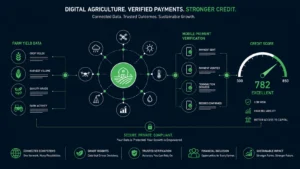

As we navigate through 2026, the strategic deployment of advanced artificial intelligence and automated behavioral tracking networks is serving as the primary bridge connecting corporate institutional lenders with grassroots agrarian projects. Legacy risk management frameworks that viewed agricultural loans as a low-margin gamble are being replaced by highly precise, algorithmic volatility engines. By transforming everyday agricultural inputs and ecological variables into live financial data nodes, modern financial inclusion platforms allow underwriting firms to verify a farm’s economic potential instantly. This absolute digital visibility eliminates the friction that historically plagued rural lending, paving the way for progressive producers to secure affordable capital while dramatically minimizing default risks for global banking syndicates.
The Data Pipeline: How AI Formulates Agricultural Credit Worthiness
The technological engine driving the modernization of rural risk underwriting is the programmatic extraction of alternative agricultural datasets. Rather than demanding physical assets for collateral, modern fintech risk management architectures utilize a multi-layered automated processing pipeline to capture and translate raw rural activity into objective risk analytics.
Specifically, advanced machine learning risk models ingest and synthesize unstructured non-traditional data arrays through a structured, multi-stage analytical process:
- Multi-Spectral Satellite Data Ingestion: The underwriting engine automatically pulls hyper-local, multi-spectral weather satellite data and historical crop canopy remote sensing imagery across a multi-year timeline to map the exact geographic field perimeters.
- Algorithmic Crop Yield Simulation: The integrated AI parses the satellite remote sensing matrices—including historical rainfall patterns, vegetative growth index values, and surface temperature anomalies—to accurately model the farm’s historical yield resilience during previous drought shocks.
- Digital Input Transaction Aggregation: The platform captures real-time data from digitized agricultural supply chains, tracking the exact purchase volumes, timing regularities, and premium quality metrics of fertilizer and biological seed inputs via local mobile wallet points of sale.
- Alternative Credit Scoring Generation: The machine learning system cross-references the historical agronomic output capabilities with the farmer’s transactional purchasing behavior, calculating a highly accurate predictive default probability index and generating an instant alternative credit scoring profile for the institutional lender.
By converting daily field operations into structured, fraud-proof digital financial records, these automated analytics platforms allow thin-file agricultural producers to safely satisfy the rigid risk validation benchmarks of international financial institutions without ever needing a traditional bank account.
Related Insights


The Operational Safeguard: Lowering Non-Performing Loan Liabilities
Corporate financial officers, international wealth managers, and regional commercial banks evaluate precision agritech underwriting frameworks through a strict quantitative risk lens. The absolute core value proposition of deploying alternative credit scoring models is the drastic optimization of loan performance across volatile geographic portfolios.
- Eradication of Systemic Adverse Selection: By running continuous algorithmic validations on real-time field data, lenders can easily isolate highly efficient, proactive farmers from high-risk, unmitigated operations, ensuring capital is distributed exclusively to productive nodes.
- Predictive Proactive Loan Restructuring: If weather satellite telemetry flags an incoming extreme localized weather anomaly, the cloud platform triggers automated warnings to lenders, allowing them to adjust repayment schedules dynamically before default vulnerabilities manifest.
- Reduction in Loan Administration Overhead: Automating the due diligence loop through centralized AI pipelines eliminates the high cost of dispatching manual physical credit adjusters to isolated rural topologies, slashing variable operational underwriting fees.
This operational framework clearly proves that integrating non-traditional credit data should never be categorized as a secondary financial technology experiment; rather, it functions as an active, high-yield asset protection hedge that systematically stabilizes banking asset portfolios against macroeconomic and climate shocks.
Cross-Platform Synergy within the Broad Rural Finance Architecture
The deep economic transformation triggered by the widespread deployment of alternative credit scoring reaches its maximum efficiency when it interfaces directly with existing, data-driven rural financial architectures. The highly reliable digital identities and credit validations established via automated data tracking serve as the critical infrastructure that unlocks a diverse spectrum of sophisticated wealth-building tools, permanently formalizing the economic landscape of smart villages.
This cross-platform technical connectivity creates an incredibly resilient, self-reinforcing financial framework. For instance, the reliable credit profiles generated via precision data tracking directly accelerate regional mobile wallet adoption rates by allowing local merchants to access credit natively through digital applications. Furthermore, this absolute transactional visibility allows thin-file producers to satisfy the strict risk validation benchmarks of advanced de-risking rural credit initiatives tracked heavily by the global financial dataset managed by the Consultative Group to Assist the Poor (CGAP). By removing historical borrowing barriers, local cooperatives can safely protect their yields against extreme weather volatility via automated climate-indexed parametric insurance models, secure long-term capital through fixed-income portfolios raised via structured rural green bonds, optimize their raw material pipelines via corporate sustainable supply chain finance networks, and access advanced machinery through asset-backed financing configurations, ensuring the entire village network seamlessly qualifies for competitive resources distributed through global international green grants.
According to comprehensive microfinance research briefs published by the International Monetary Fund (IMF), building deep operational ties between distributed digital credit underwriting platforms and localized mobile financial channels is the single most effective methodology to protect rural microcredit networks from systemic default risk. It guarantees that foreign investment capital circulates exclusively within productive, wealth-generating rural channels, completely isolated from corporate administrative leakage or local political instability at every stage of the asset lifecycle.

Conclusion
The global expansion of alternative credit scoring across emerging markets marks a permanent, structural evolution in international development finance, turning the historic challenge of agricultural risk into a highly secure, data-verified commercial opportunity for global capital pools. By replacing old, exclusive, and document-heavy legacy credit assessment methods with automated machine learning risk engines, real-time satellite observation, and frictionless transaction ledgers, the global fintech movement has successfully built an unassailable highway toward universal financial inclusion. The historical constraints of geographical isolation, lack of formal property documentation, and deep informational asymmetry are no longer absolute barriers to economic self-reliance. As decentralized data architectures continue to mature, automated underwriting platforms achieve absolute consensus transparency, and corporate ESG mandate compliance intensifies across all international borders, the rural agricultural networks that confidently integrate with these digital financial inclusion platforms will secure their position as the highly resilient, self-sustaining, and prosperous anchors of the modern global economy.