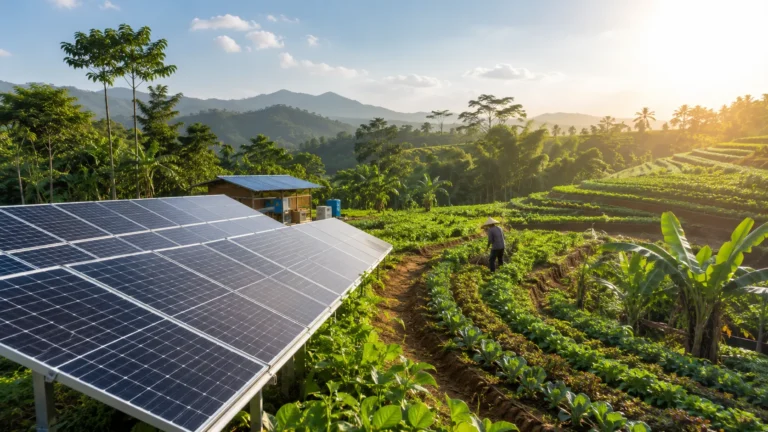

The stabilization of high-yield agricultural zones amidst escalating climate volatility requires highly targeted, localized capital intervention. While national sovereign guarantees and international climate funds dictate the macroeconomic landscape, the actual execution of agricultural modernization often depends on agile, sub-regional fiscal policy. California, representing one of the largest and most technologically advanced agricultural economies on the planet, serves as a premier global laboratory for decentralized climate finance.
Related Insights

Facing persistent megadroughts and stringent environmental regulatory mandates, California’s agribusinesses require massive capital expenditures to upgrade their irrigation and energy grids. However, funding these foundational resilience upgrades exclusively through private commercial debt places an unbearable financial strain on rural producers. To resolve this structural friction, the state has engineered a highly effective sub-regional equity deployment model. By weaponizing its cap-and-trade revenue, the California Department of Food and Agriculture (CDFA) systematically redistributes capital back into the rural economy through specialized grant frameworks, directly funding the essential infrastructure required to sustain the state’s multi-billion-dollar agrarian output.
As global economic planners evaluate sub-national climate financing into 2026, California’s CDFA grant architecture—most notably the State Water Efficiency and Enhancement Program (SWEEP)—stands out as a globally replicable blueprint. Unlike traditional passive subsidies, CDFA frameworks operate as highly strategic, data-driven equity deployments. The state identifies specific operational vulnerabilities—such as groundwater depletion or diesel-powered pump emissions—and provides non-repayable capital directly to farmers to install automated soil moisture sensors, precision micro-irrigation arrays, and decentralized solar micro-grids.
This institutional brief evaluates the macroeconomic mechanics of California’s cap-and-trade revenue redistribution, detailing how the CDFA successfully mitigates the financial risk of agrarian decarbonization, lowers operational overhead for rural cooperatives, and catalyzes long-term commercial investment across the rural agribusiness sector.
Capitalizing on Cap-and-Trade: The Economics of SWEEP
To fully grasp the commercial brilliance of the CDFA framework, one must analyze the origin of its capital pool. California operates a rigorous cap-and-trade program managed by the California Air Resources Board (CARB). This system forces the state’s largest industrial greenhouse gas (GHG) emitters to purchase carbon allowances. Instead of letting this massive capital reserve sit idle, the state aggressively recycles it into the California Climate Investments (CCI) fund. The CDFA draws directly from this fund to capitalize programs like SWEEP.
Related Insights


The economic logic underpinning SWEEP is highly targeted dual-optimization. When a rural agribusiness applies for a SWEEP grant, they must mathematically prove that the proposed infrastructure upgrade will achieve two simultaneous metrics: a measurable reduction in on-farm water consumption and a quantifiable decrease in localized greenhouse gas emissions. If the data aligns, the state deploys the grant.
- Eradicating CapEx Barriers: Precision agriculture—such as variable-frequency drive (VFD) water pumps and automated telemetry valves—requires a prohibitive upfront capital expenditure (CapEx). By covering up to 100% of these specific hardware costs, SWEEP allows farmers to modernize immediately without depleting their working capital reserves.
- Permanent Operational Cost Reduction: While the grant covers the hardware, the farmer reaps the long-term operational savings. Dramatically reducing water waste and transitioning from diesel to solar-powered irrigation drastically lowers monthly utility overhead, instantly widening the farm’s baseline profit margins.
- Regulatory Compliance Insulation: As groundwater regulations (such as California’s SGMA) tighten, farms without efficient infrastructure face severe operational penalties or complete operational shutdowns. CDFA grants proactively insulate rural economies from these regulatory shocks by bringing them into compliance ahead of state deadlines.
By effectively treating state climate funds as catalytic equity, California ensures that its rural agribusinesses remain highly competitive on the global export market despite operating in one of the most heavily regulated environmental jurisdictions in the world.
Bypassing Commercial Debt for Foundational Infrastructure
The strategic deployment of sub-regional grants addresses a fundamental market failure in agricultural commercial lending. Traditional commercial banks are highly eager to finance revenue-generating assets, such as a new processing facility or expanded acreage. However, they are historically hesitant to finance defensive, non-revenue-generating infrastructure—such as a water conservation system. While saving water is ecologically vital, it does not necessarily create a new commercial product line that easily services a high-interest loan.
CDFA grant frameworks bridge this exact gap. By utilizing public equity to fund the defensive infrastructure, the state fundamentally de-risks the agribusiness’s balance sheet.
“The strategic redistribution of cap-and-trade revenues into targeted agricultural grants represents a masterclass in sub-regional economic governance. By utilizing public capital to absorb the costs of foundational water and energy infrastructure, states effectively bulletproof their rural economies against climate shocks, establishing a de-risked baseline that aggressively crowds-in secondary commercial investment.”
Once a farm is fully modernized and stabilized by state grants, its risk profile drops significantly, making the operation a highly attractive candidate for subsequent commercial loans aimed at aggressive corporate expansion.

Synergizing Sub-Regional Grants with the Global FinTech Ecosystem
The macroeconomic acceleration achieved by California’s CDFA grant frameworks reaches its absolute peak commercial velocity when it interfaces with advanced rural financial architectures. The state-level logic of deploying catalytic public capital directly mirrors international frameworks, such as the EAFRD financial instruments in Europe and the innovative capital blending in BUMDes within Southeast Asia. Across all geographies, public equity is the required catalyst for private capital mobilization.
This cross-platform technical connectivity creates an incredibly resilient economic loop. To secure and maintain compliance for a SWEEP grant, California agribusinesses must integrate advanced digital water meters and energy telemetry. This pristine operational data subsequently allows them to leverage alternative data credit scoring when dealing with commercial lenders.
Once the foundational infrastructure is secured by the state grant, the agribusiness can confidently utilize federal backing, such as sovereign loan guarantees through the USDA, to acquire heavy harvesting machinery. Furthermore, because their water supply is now technologically optimized and highly efficient, these farms drastically lower their risk profile, allowing them to secure highly favorable premiums on area-yield index insurance and parametric weather-index insurance. Ultimately, this comprehensive, multi-tiered capitalization strategy positions California’s rural networks to consistently capture massive institutional investments, securing their status as the most resilient agricultural hubs in the modern global economy.
Conclusion
The strategic deployment of sub-regional equity through California’s CDFA grant frameworks marks a definitive paradigm shift in the execution of localized climate finance. By brilliantly repurposing industrial cap-and-trade revenues into specialized agricultural modernization grants, state policymakers have engineered a frictionless pipeline that funds critical water and energy infrastructure without burying rural producers in commercial debt. The historical constraints of severe environmental regulation, extreme capital expenditure barriers, and regional water scarcity are actively being neutralized by targeted, data-driven public investment.
As global climate volatility continues to escalate and international asset managers seek highly resilient agricultural supply chains, the sub-regional economic models modeled after California’s SWEEP program will serve as the premier blueprint for securing long-term agrarian prosperity and unassailable domestic food security.