

Executive Summary: The global voluntary carbon market (VCM) is undergoing a profound structural evolution, shifting rapidly from speculative offsets toward high-integrity, legally verifiable climate assets. For global climate funds, ESG-focused institutional investors, and corporate compliance buyers, the search for authentic carbon sequestration projects has driven capital away from opaque, centralized plantations and toward community-based conservation initiatives.
Related Insights

At the absolute forefront of this transition in Southeast Asia is the monetization of village-managed forests, locally known as Hutan Desa. By legally empowering rural villages to manage, protect, and monetize their surrounding ecosystems, these communities can establish multi-decade revenue streams entirely independent of destructive timber extraction. This strategic briefing details how sophisticated international climate funds can partner directly with village enterprises to structure bankable Carbon Credit Portfolios.
The macroeconomic rationale for investing in community-managed carbon assets is anchored in permanence, additionality, and robust social co-benefits. Historically, rural forestry assets were vulnerable to illegal logging and agricultural encroachment due to economic desperation and a lack of localized conservation incentives. By implementing structured Carbon Credit Portfolios managed through localized Badan Usaha Milik Desa (BUM Desa) cooperatives, international capital can directly finance community patrolling, regenerative agroforestry, and advanced Measurement, Reporting, and Verification (MRV) technologies.
This transforms indigenous forest stewards into institutional-grade carbon asset managers, ensuring that capital deployment achieves both rigorous climate mitigation and transformative social upliftment, aligning seamlessly with broader initiatives in capitalizing on the green transition.
For institutional portfolio managers and specialized carbon asset syndicates, unlocking this asset class requires navigating complex legal frameworks, land tenure rights, and international registry standards. When properly structured, village-owned forest carbon credits command premium pricing in global markets due to their exceptional biodiversity co-benefits and community-level impact. This executive report explores the financial mechanics, technological telemetry, and legal safeguards required to transform tropical forest canopies into high-yield, long-duration climate investments.
Related Insights

The Mechanics of Hutan Desa and Verifiable Carbon Offsets
To successfully issue tradeable carbon credits from community forests, investors must first comprehend the statutory framework of the Hutan Desa (Village Forest) scheme. Under national forestry decrees, local governments grant village communities the legal right to manage designated state forest areas for a multi-decade term. While this statutory right prevents commercial clear-cutting, it historically left villages without sustainable financing mechanisms to fund active forest protection. Establishing structured Carbon Credit Portfolios bridges this economic gap by monetizing the avoided deforestation and enhanced carbon sequestration of the standing canopy.
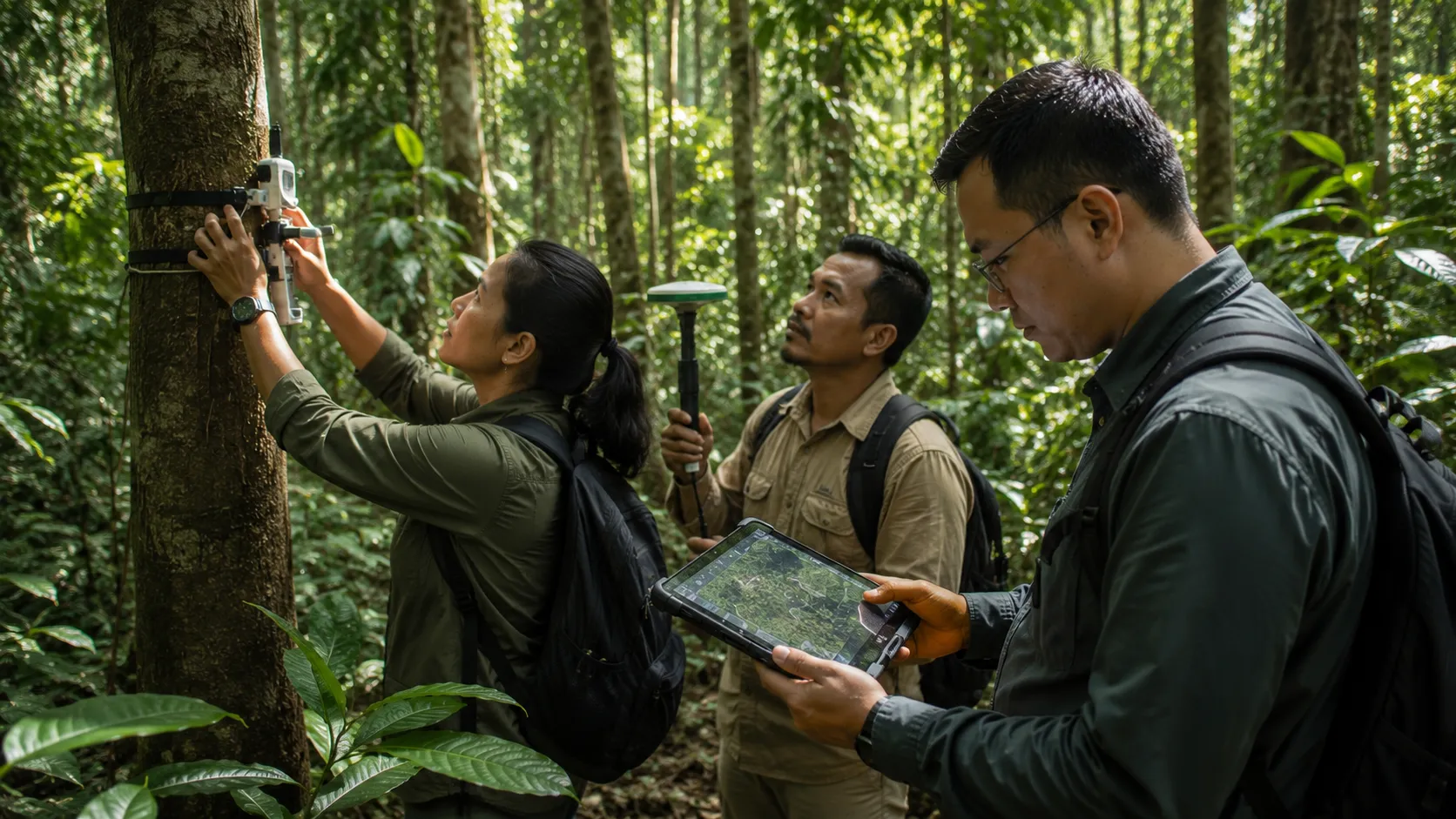
The operational lifecycle of a village carbon project begins with rigorous baseline establishment and carbon stock quantification, executed in strict accordance with international standards set by registries such as Verra (VM0048 or REDD+ methodologies). Specialized project developers and climate tech funds deploy LiDAR scanning, drone telemetry, and permanent sample plots to measure above-ground biomass. Once the baseline emissions are calculated, every ton of carbon dioxide equivalent (tCO2e) prevented from entering the atmosphere through community patrols and fire management is minted into verifiable carbon credits. This rigorous scientific framework ensures absolute credibility, shielding corporate buyers from the greenwashing scrutiny that plagued earlier generations of carbon offsets.
Furthermore, integrating these localized forestry projects with advanced blended finance frameworks for rural enterprises ensures that initial capital expenditures for MRV deployment are heavily de-risked. By leveraging first-loss capital guarantees alongside international carbon finance, institutional investors can fund the upfront validation and verification audits required before credits reach the voluntary market.
BUM Desa Partnerships and Decentralized Governance
A critical operational hurdle in tropical forestry carbon projects is ensuring that revenue distribution reaches the grassroots level without suffering from bureaucratic leakage or elite capture. The institutional answer to this governance challenge is anchoring the project through the BUM Desa (Village-Owned Enterprise). As a legally recognized corporate entity, the BUM Desa acts as the centralized commercial representative for the village, executing binding agreements with international carbon buyers and managing the influx of foreign climate finance.
When international climate funds acquire carbon credits from village-owned forests, the financial proceeds flow directly into the BUM Desa corporate account under strict international escrow protocols. A pre-agreed governance charter dictates the allocation of these revenues: a fixed percentage is reinvested into advanced forest monitoring equipment and ecological restoration, another tranche funds community-wide healthcare and educational infrastructure, and remaining dividends are distributed equitably to participating households. This direct financial feedback loop creates an unbreakable economic alignment between community prosperity and forest preservation.
This decentralized governance model also serves to neutralize local political risks. When the entire village populace experiences tangible financial dividends from standing trees rather than illegal logging, community-led policing becomes vastly more effective than state-enforced policing. This operational stability mirrors the rigorous supply chain governance found in successful models of securing multinational supply chains through BUM Desa aggregation, where localized accountability drives enterprise resilience.

Strategic Advisory for Climate Fund Allocators
For global climate funds, ESG-focused private equity, and multinational corporate treasuries looking to acquire premium carbon assets, establishing exposure to village-managed forests requires a rigorous, multi-disciplinary due diligence protocol. We advise institutional allocators to prioritize the following three strategic pillars:
- Rigorous Legal Tenureship Audit: Verify that the target Hutan Desa possesses an unencumbered, long-term operational decree from the Ministry of Environment and Forestry. Avoid projects with overlapping agrarian claims or unresolved boundary disputes.
- Long-Term Buffer Pool Insurance: Ensure that project developers allocate a conservative percentage of issued credits (typically 20% to 30%) into pooled non-permanence risk buffers to protect against catastrophic events like forest fires or extreme weather anomalies.
- Transparent Benefit-Sharing Agreements: Mandate legally binding benefit-sharing mechanisms that guarantee micro-payments directly to indigenous and local land stewards, satisfying the highest international social safeguard standards.
Conclusion
The monetization of tropical forest canopies through structured Carbon Credit Portfolios represents one of the most compelling intersections of ecological preservation and institutional finance in 2026. By bridging the gap between international climate capital and empowered village enterprises via BUM Desa governance, global investors can secure high-integrity carbon offsets while catalyzing sustainable rural development. Those institutional funds that master the rigorous technical, legal, and operational nuances of village-owned forest carbon assets today will command an unassailable leadership position in the global voluntary carbon market.