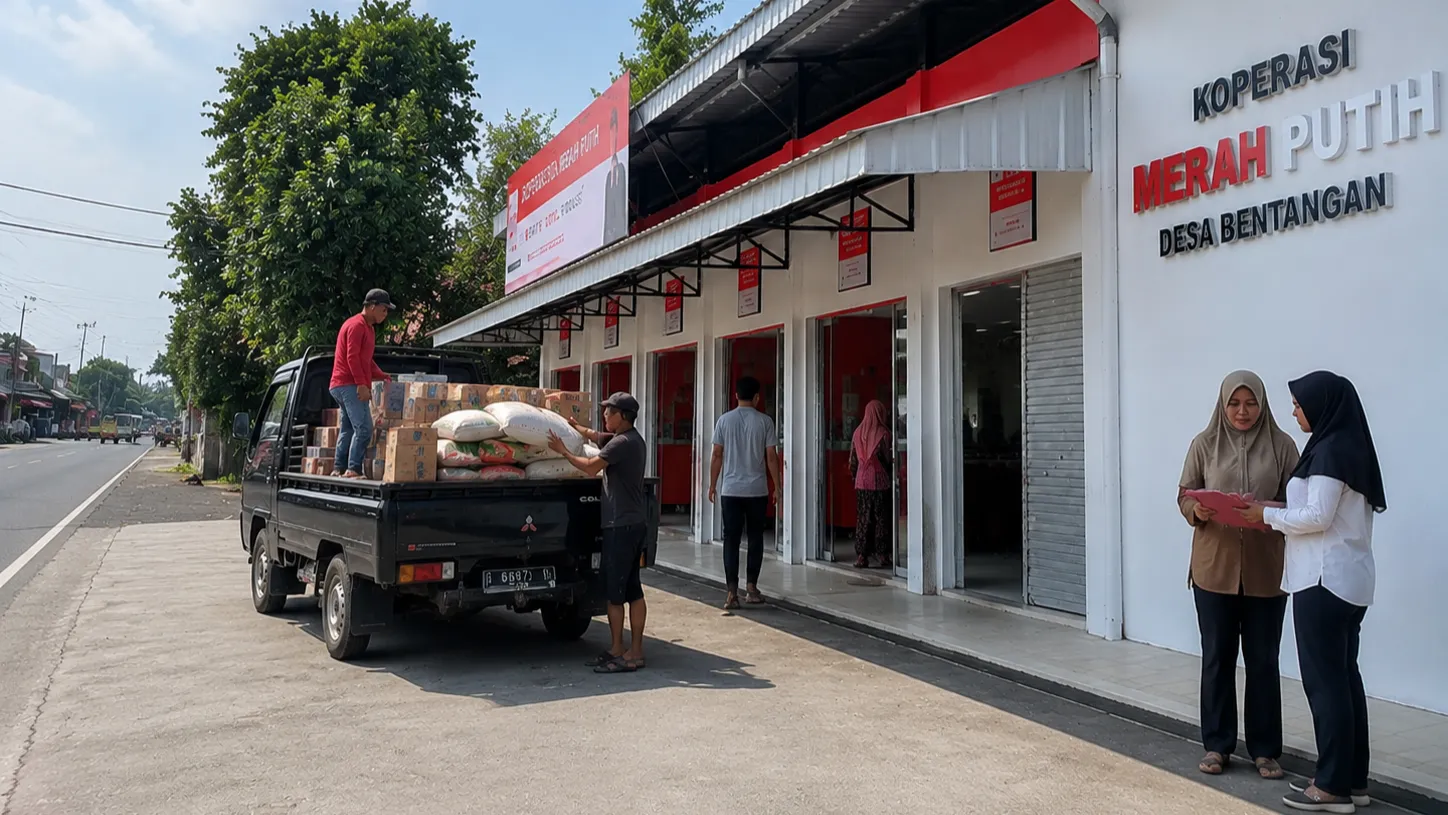
The architecture of rural corporate finance in Southeast Asia’s largest economy is undergoing a massive structural stress test. In an ambitious maneuver to stimulate localized food security and economic velocity, the Indonesian government has heavily capitalized a new network of localized agricultural hubs known as Kopdes Merah Putih (Red and White Village Cooperatives). According to recent fiscal disclosures cited by local financial outlet Detik Finance, this initiative injected up to Rp 3 billion in credit into individual village cooperatives. The capital was aggressively fronted by the Association of State-Owned Banks (Himbara). Now, the grace period is rapidly compressing. Market observers are closely tracking the upcoming Kopdes debt repayment cycle, which is officially scheduled to commence this September, offering a real-time gauge of how the sovereign balance sheet manages heavily decentralized rural liabilities.
Following a high-level limited cabinet meeting at the Presidential Palace in Central Jakarta this Thursday, Coordinating Minister for Food Zulkifli Hasan confirmed the rigid settlement timeline. The initial installment from the managing entity, Agrinas Pangan, directed toward the state banking syndicate will hit its primary maturity window in September 2026. For institutional credit analysts and sovereign debt strategists, the mechanics of this specific Kopdes debt repayment mandate careful scrutiny. The fundamental structure of this credit facility effectively bypasses traditional retail default risk by positioning the central government as the ultimate guarantor, utilizing rigid statutory allocations to satisfy commercial banking obligations.
The capital source designated to clear these banking obligations is not organic cooperative revenue. Instead, the administration has authorized the use of the State Revenue and Expenditure Budget (APBN), specifically drawing down from the national Dana Desa (Village Fund) allocations. By utilizing sovereign budget lines to retire commercial debt originated by state banks, the government is essentially conducting an internal fiscal transfer. While this heavily shields the Himbara banking syndicate from localized non-performing loan (NPL) spikes, it fundamentally alters the liquidity dynamics of regional governments that traditionally rely on the Village Fund for grassroots infrastructure and direct social assistance.

Governance Frameworks and the Mechanics of Kopdes Debt Repayment
Executing a capital transfer of this magnitude across thousands of decentralized rural entities requires a formidable compliance architecture. Recognizing the inherent risks of localized revenue leakage, the central administration has mandated rigorous multi-tier auditing prior to the release of any settlement capital. Before the Ministry of Finance executes a single ledger entry for a Kopdes debt repayment, every transaction must undergo strict verification and validation by the Development Finance Comptroller (BPKP).


This statutory requirement functions as a critical anti-graft firewall. Zulkifli Hasan explicitly noted that the Ministry of Finance, under the direction of Minister Purbaya Yudhi Sadewa, will only authorize direct wire transfers to the Himbara network once the BPKP delivers a clean bill of financial health for the respective cooperative. This governance layer is intended to ensure that the initial Rp 3 billion credit injections were actually deployed for their intended agricultural and logistical purposes, rather than being diverted into shadow municipal expenditures. For risk managers working within the state banking sector, this layered validation process radically reduces credit risk, a dynamic we recently explored in our broader analysis on navigating liquidity risks in rural microfinance.
However, the heavy reliance on BPKP auditing introduces severe bottleneck risks. The September deadline is rigid, yet the comptroller’s capacity to audit thousands of remote agrarian cooperatives within a compressed temporal window remains largely untested. Any administrative delay in the verification pipeline could technically force specific cooperatives into temporary arrears, even though the sovereign capital required to clear the debt is already sitting in the Ministry of Finance’s treasury accounts. State banks must actively adjust their short-term liquidity models to account for these probable bureaucratic frictions.
Capital Expenditure Versus the Operational Runway
Beyond the raw mechanics of the impending Kopdes debt repayment, a much deeper structural concern is currently occupying the minds of national fiscal planners. Minister of Finance Purbaya Yudhi Sadewa recently issued a stark public warning regarding the localized capital allocation strategies of these cooperatives. A Rp 3 billion credit facility represents a staggering volume of liquidity for a standard Indonesian village. The fundamental objective of this capital was to build physical infrastructure—such as storage silos, cold chain facilities, and processing equipment—while simultaneously reserving sufficient working capital to actually operate the enterprise.
Speaking from the Presidential Palace complex earlier in the week, Purbaya emphasized a classic corporate finance vulnerability: excessive capital expenditure (CapEx) starving operational expenditure (OpEx). “It shouldn’t just be for construction,” Purbaya noted, stressing that a significant portion of the bank loans must be preserved to sustain daily operations. If local cooperative boards aggressively burn through their entire credit facility building oversized, aesthetically pleasing retail storefronts or warehouses without reserving cash to purchase harvest yields or pay logistical staff, they will face immediate insolvency long before they generate their first rupiah of organic revenue.
This scenario underscores the profound difference between capital injection and enterprise viability. The state can force liquidity into rural areas via the Himbara network, and it can guarantee the ultimate Kopdes debt repayment utilizing the Village Fund. Yet, if the underlying cooperative businesses fail to achieve basic commercial viability due to gross capital mismanagement, the state is simply subsidizing empty buildings. The long-term macroeconomic objective is to transition these cooperatives into self-sustaining entities capable of functioning without a continuous sovereign drip-feed.

As the September maturity window approaches, global economists evaluating the integrity of Indonesia’s decentralized fiscal strategy are watching closely. Institutions requiring deeper baseline data on the historical performance of Indonesian rural infrastructure spending frequently reference World Bank macroeconomic assessments of Indonesia to contextualize these localized fiscal maneuvers. Ultimately, the successful execution of this debt settlement cycle will determine whether the Kopdes Merah Putih initiative matures into a robust engine for domestic food security, or merely evolves into a permanent, highly illiquid liability on the national balance sheet.