Executive Summary: As global maritime protein demand accelerates toward 2030, commercial aquaculture—specifically intensive coastal shrimp (Penaeus vannamei) farming and marine finfish cultivation—has emerged as the primary mechanism for global seafood security. With wild-capture fisheries facing irreversible biological exhaustion, the commercial burden of supplying premium, protein-dense seafood to North American, European, and East Asian markets rests entirely upon farmed marine supply chains. Yet, despite generating multi-billion-dollar export valuations across Southeast Asia and Latin America, commercial aquaculture suffers from severe structural credit rationing.
Tier-1 commercial banks, institutional asset managers, and trade finance syndicates have historically redlined marine producers, viewing coastal farming as an uninvestable, highly volatile asset class plagued by biological opacity, catastrophic disease outbreaks, and severe environmental compliance deficits. However, a sweeping technological and financial paradigm shift is transforming this sector. By institutionalizing Sustainable Aquaculture Financing, global capital allocators can systematically replace underwater biological speculation with data-driven biophysical certainty, unlocking massive green debt facilities for export-grade marine producers.
The macroeconomic paradox defining coastal aquaculture is rooted in collateral impairment. In traditional agricultural credit, lenders can visually inspect standing terrestrial crops or seize physical land title in the event of default. In commercial shrimp farming, the primary underlying asset—millions of high-value marine crustaceans—resides beneath two meters of turbid water. Historically, lenders had zero visibility into pond health until a catastrophic biological event occurred.
Pathogens such as Early Mortality Syndrome (EMS), acute hepatopancreatic necrosis disease (AHPND), and White Spot Syndrome Virus (WSSV) can wipe out 100% of a commercial pond’s biological collateral within 48 hours. When combined with strict export rejection risks at international ports due to antibiotic residues or deforestation-linked feed inputs, commercial banks systematically adjusted their risk premiums to prohibitive levels, locking marine producers out of institutional debt markets.
Related Insights


Today, the convergence of real-time Internet of Things (IoT) water quality telemetry, automated parametric risk modeling, and immutable blockchain traceability has completely rewritten the underwriting architecture of marine cultivation. Modern Sustainable Aquaculture Financing frameworks decouple debt issuance from traditional brick-and-mortar collateral, tethering credit facilities directly to verified biophysical data and binding export offtake contracts. For chief risk officers, green bond syndicates, and agribusiness venture capital funds, mastering this financial infrastructure is essential for capturing high-yield, uncorrelated returns while satisfying aggressive Scope 3 decarbonization mandates.
This executive advisory report delivers an exhaustive macro-financial evaluation of export-grade seafood financing. We dissect the engineering economics of automated pond telemetry, evaluate the structural mechanics of blended green credit facilities, and outline the strategic governance frameworks required to scale sustainable marine protein across emerging coastal economies.
Biophysical Opacity and Parametric Underwriting via IoT Telemetry
To systematically engineer risk out of commercial aquaculture lending, institutional credit committees must solve the fundamental problem of biophysical opacity. In legacy banking models, a farm’s creditworthiness was evaluated using static, retrospective financial statements and manual, infrequent water testing logs. This manual underwriting approach is structurally obsolete for intensive marine cultivation, where biological stability depends on maintaining precise, intraday equilibrium across complex biochemical variables. Any sudden fluctuation in dissolved oxygen (DO), pH, temperature, turbidity, or total ammonia nitrogen (TAN) immediately triggers physiological stress in marine biomass, exponentially suppressing immune response and inviting rapid pathogen proliferation.
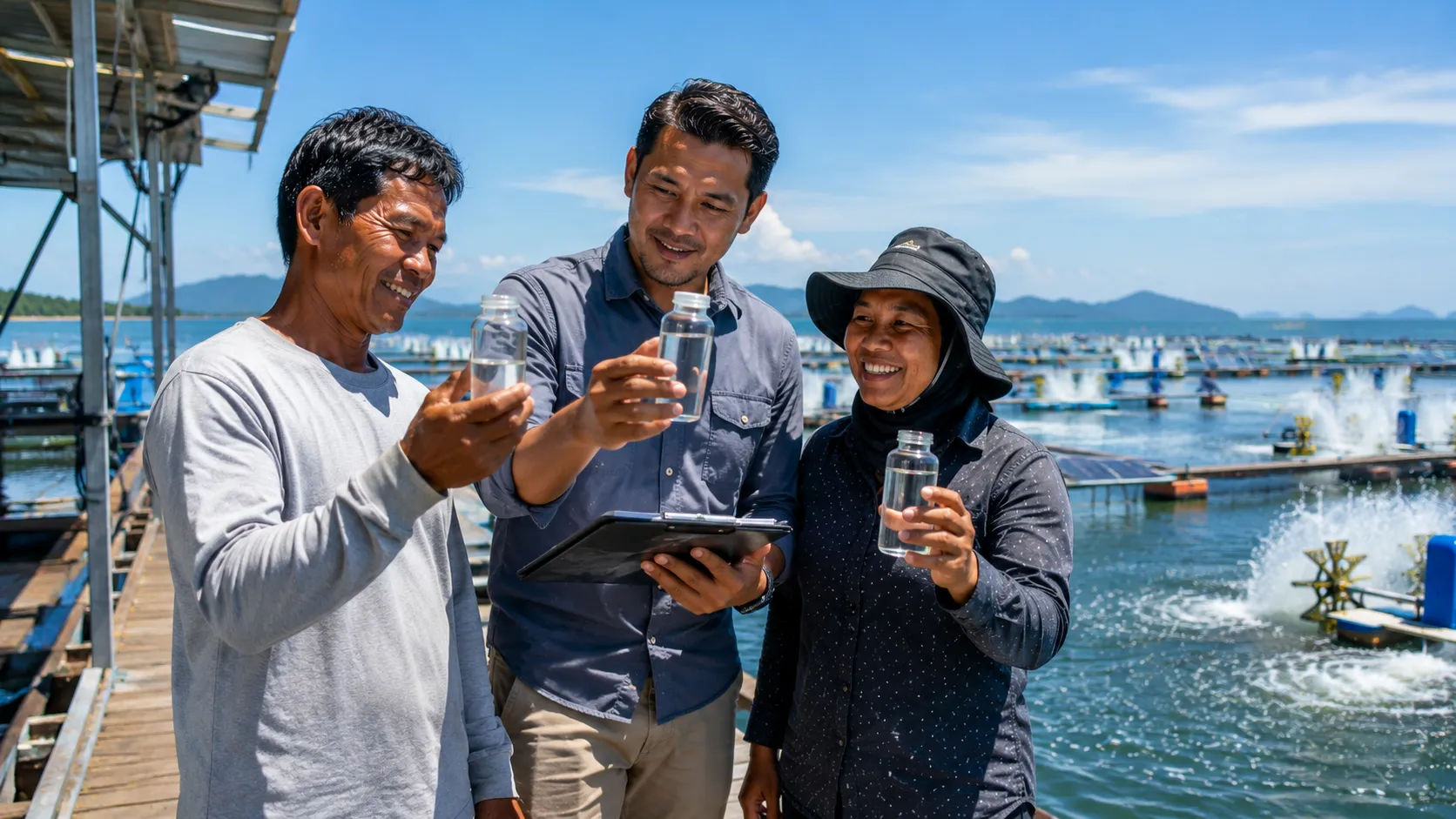
Modern Sustainable Aquaculture Financing replaces static underwriting with continuous, algorithmic risk assessment driven by automated IoT telemetry arrays deployed directly into commercial grow-out ponds. These submerged sensor networks continuously transmit real-time biophysical telemetry to cloud-based credit monitoring dashboards operated by lending institutions and insurance underwriters.
By utilizing machine learning algorithms calibrated against biological growth curves, banks can calculate a farm’s exact biological asset valuation on an hourly basis, monitoring feeding efficiency, biomass accretion, and environmental stability without setting foot on the coastal facility.
Related Insights

Crucially, this continuous data stream enables the implementation of dynamic, risk-adjusted interest rate pricing and parametric loan covenants. Rather than charging a static, inflated interest rate to cover anticipated biological losses, institutional lenders deploy algorithmic pricing matrices where the cost of capital dynamically adjusts based on verified pond telemetry. We can formalize this dynamic underwriting relationship by defining a real-time Credit Risk Adjustment Factor ($\Delta r$) added to or subtracted from the base lending rate ($r_{base}$):
$$\Delta r = \alpha \left( \frac{DO_{target} – DO_{actual}}{DO_{target}} \right) + \beta \left( \sigma_{pH}^2 \right) + \gamma \left( \frac{TAN_{actual}}{TAN_{max}} \right)$$
In this institutional equation, $\alpha$, $\beta$, and $\gamma$ represent empirically derived risk coefficients assigned by credit underwriters; $DO$ represents dissolved oxygen saturation; $\sigma_{pH}^2$ denotes the intraday variance in pH levels; and $TAN$ tracks toxic ammonia concentration. When a producer’s IoT telemetry demonstrates uncompromising biophysical stability—maintaining optimal dissolved oxygen and minimizing chemical variance—the algorithmic smart contract automatically compresses the lending spread, rewarding the farmer with discounted interest rates.
Conversely, if telemetry detects chronic environmental stress, the system automatically triggers an underwriting alert, initiating mandatory technical extension intervention or activating pre-structured parametric weather and disease index insurance before a catastrophic biological mortality event can impair the bank’s principal.
Green Export Compliance, Traceability, and Antimicrobial Stewardship
While biophysical pond stability protects the underlying biomass during the cultivation cycle, the ultimate test of liquidity in Sustainable Aquaculture Financing occurs at the international customs terminal. Marine shrimp and finfish are among the most heavily scrutinized food commodities entering the European Union, the United States, and Japan.
Related Insights


Western regulatory authorities enforce uncompromising sanitary and phytosanitary (SPS) standards, deploying sensitive high-performance liquid chromatography (HPLC) testing to screen incoming shipments for antimicrobial and antibiotic residues—specifically banned substances such as chloramphenicol, nitrofurans, and oxytetracycline. A single detection of banned residue triggers immediate shipment rejection, border destruction orders, and mandatory port-of-entry blacklisting for the regional exporting syndicate.
Furthermore, under emerging environmental legislation such as the EU Deforestation Regulation (EUDR) and international blue carbon protection mandates, export-grade seafood producers must mathematically prove that their marine feed inputs (specifically fishmeal and agricultural soybean meal) are zero-deforestation compliant, and that their coastal pond excavation did not destroy protected mangrove ecosystems.
Lenders who finance non-compliant marine producers face severe collateral stranding when export consignments are rejected at Western borders, transforming a performing commercial loan into an immediate non-performing loan (NPL).
To immunize debt portfolios against regulatory border friction, institutional capital deploying into Sustainable Aquaculture Financing must mandate absolute antimicrobial stewardship and automated RegTech traceability. By integrating pond-level IoT data with distributed ledgers, export producers cryptographically seal every inputs event—logging certified organic feed batches, probiotic water treatments, and complete absence of antibiotic applications onto an immutable blockchain ledger.
This digital chain of custody accompanies the harvested biomass from pond extraction through processing hubs and into temperature-controlled containers governed by solar-powered cold chain logistics infrastructure.
Related Insights

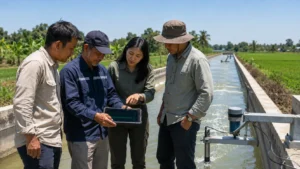
When the consignment arrives at European or North American ports, customs auditors and commercial buyers scan the digital bill of lading, verifying end-to-end biological compliance and provenance data in real time. This automated compliance architecture integrates seamlessly with institutional RegTech compliance mandates, eliminating port inspection delays and guaranteeing instantaneous trade finance settlement. As documented by international fisheries frameworks published by the Food and Agriculture Organization (FAO), verifiable antimicrobial stewardship and transparent traceability are the single most critical prerequisites for securing long-term market access and institutional investment in the global aquaculture sector.

Structuring Blended Capital and Coastal BUM Desa Aggregation
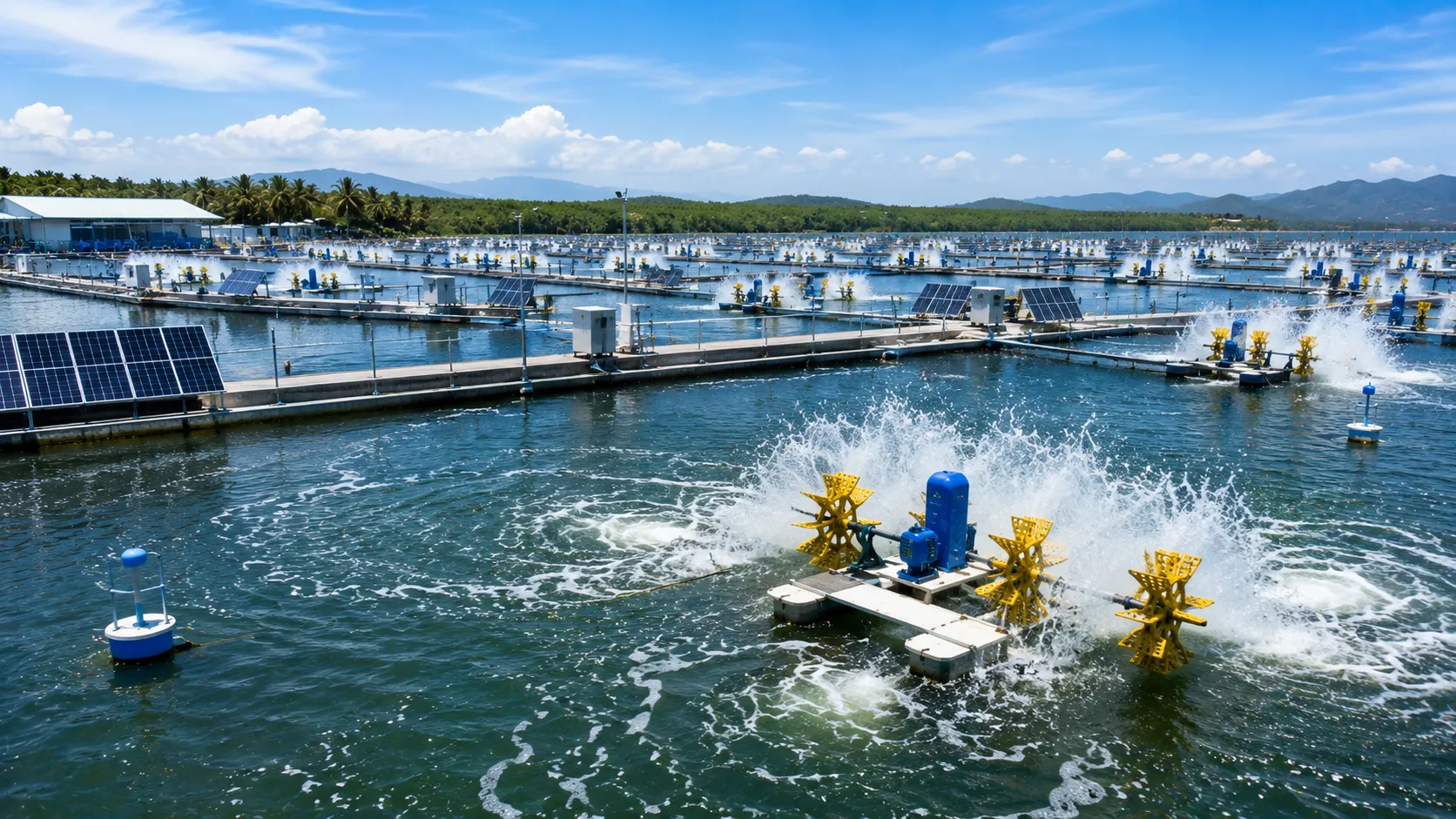
Despite the compelling risk-adjusted returns of modernized marine cultivation, the capital expenditure (CapEx) required to upgrade traditional coastal farms to institutional standards represents a massive financial hurdle. Individual small- and medium-scale shrimp farmers lack the balance sheet liquidity to independently purchase high-capacity paddlewheel aerators, automated acoustic feeding systems, solar photovoltaic arrays, and submerged IoT telemetry sensors. If institutional lenders attempt to issue commercial loans directly to fragmented smallholders without structural aggregation and CapEx underwriting, credit default rates will remain unacceptably high.
The institutional solution to this capital deployment bottleneck is the architecture of blended finance structured through formalized coastal village-owned enterprises (Badan Usaha Milik Desa / BUM Desa) or regional grower cooperatives. Instead of financing thousands of disaggregated smallholders, institutional asset managers and green bond syndicates channel capital into centralized Special Purpose Vehicles (SPVs) co-owned by coastal BUM Desa networks.
These corporate aggregation nodes act as master borrowers and operational integrators, executing bulk procurement of high-tech aquaculture hardware and deploying it across participating smallholder ponds under an Equipment-as-a-Service (EaaS) leasing framework, closely mirroring strategies utilized in asset-backed agricultural drone and tractor leasing.
To de-risk the senior commercial debt tranches within these coastal SPVs, financial structuring teams deploy advanced capital blending. Multilateral development finance institutions—such as the World Bank Blue Economy Program or the International Finance Corporation (IFC)—inject first-loss concessional equity or issue partial credit guarantees. This catalytic public capital absorbs the initial biophysical transition risks and funds the baseline installation of coastal IoT telemetry networks.
Related Insights
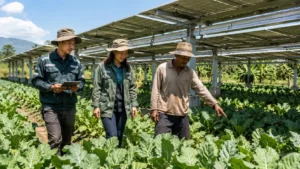
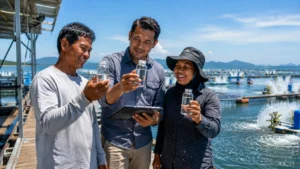
Once pond stability is empirically validated and export cash flows commence, senior institutional debt syndicates enter the structure, enjoying fully insulated credit protection. This capital stacking framework directly reflects the core principles of blended finance frameworks for rural micro-sovereign capital.
Furthermore, because modernized aquaculture systems dramatically reduce coastal nutrient loading and eliminate the necessity of destroying mangrove forests for pond expansion, these syndicated credit facilities qualify for international blue bond issuance. By aligning marine production with coastal ecological preservation, asset managers can monetize the co-benefits of their portfolios through monetizing blue carbon and marine biodiversity credits, creating a multi-layered yield architecture that delivers exceptional financial stability to institutional investors.
Strategic Advisory for Institutional Lenders and Green Debt Allocators
As the commercial maturation of the blue economy accelerates throughout 2026, Tier-1 commercial banks, trade finance syndicates, and infrastructure private equity funds must transition from passive risk avoidance to active biophysical underwriting. To capture dominant market share within Sustainable Aquaculture Financing while eliminating biological default risk, we advise executive credit committees to enforce three mandatory underwriting pillars prior to capital deployment:
- Mandate Real-Time Biophysical Telemetry Covenants: Absolutely refuse to underwrite commercial aquaculture credit facilities based on static, retrospective financial auditing. Mandate that every financed pond is equipped with cellular or satellite-linked IoT water telemetry arrays. Embed strict biological covenants into the loan agreement: if a borrower’s dissolved oxygen or toxic ammonia levels breach contractually defined biophysical thresholds for more than four consecutive hours without corrective aeration intervention, the smart contract must automatically freeze revolving working capital disbursements and notify the technical underwriting team.
- Anchor Debt Facilities to Verified Export Offtake Contracts: Never finance speculative marine production without confirmed downstream market liquidity. Require coastal BUM Desa cooperatives and commercial grower syndicates to assign legally binding, multi-year take-or-pay offtake agreements from Tier-1 international seafood conglomerates as primary collateral. Integrate these contracts with structured liquidity optimization in supply chain finance, ensuring that export proceeds from US Dollar- or Euro-denominated seafood sales flow directly into multi-signature digital escrow accounts to automatically service debt principal before domestic profit distribution.
- Structure Margin Grids Around Coastal Blue Carbon Preservation: Connect commercial lending rates directly to measurable coastal environmental stewardship. Integrate dynamic interest rate margin grids where credit spreads are systematically reduced by 50 to 100 basis points if the marine producer provides satellite-verified proof of zero mangrove deforestation and actively reforests adjacent tidal buffer zones. This structural alignment satisfies international ESG banking mandates while protecting coastal farm infrastructure against destructive storm surges and hydrodynamic erosion.
By rigorously executing these strategic directives, institutional lenders can safely unlock billions of dollars in growth capital for coastal marine producers. Adhering to comprehensive compliance frameworks regarding blockchain traceability in rural BUM Desa supply chains ensures that the physical seafood backing institutional debt is legally unencumbered and premium-valued in global export markets, establishing an unassailable competitive advantage in maritime finance.
Conclusion
The institutional deployment of Sustainable Aquaculture Financing represents the definitive structural bridge between global capital markets and the future of maritime protein security. By abandoning archaic, brick-and-mortar underwriting in favor of real-time IoT biophysical telemetry, algorithmic risk pricing, and immutable export traceability, institutional lenders can permanently de-risk commercial shrimp and marine seafood supply chains.
Related Insights
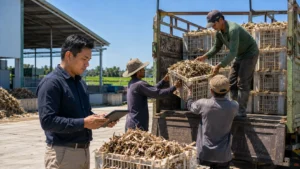

When structured through blended finance vehicles and coastal BUM Desa aggregation networks, these green debt facilities empower rural producers to acquire high-tech cultivation infrastructure without assuming prohibitive balance sheet leverage. As global seafood demand intensifies and Western green import mandates tighten throughout 2026, those institutional asset managers, commercial banks, and green bond allocators who master the biophysical, technological, and legal mechanics of sustainable marine financing will capture superior, inflation-protected yields while safeguarding the foundational marine ecosystems of the developing world.